
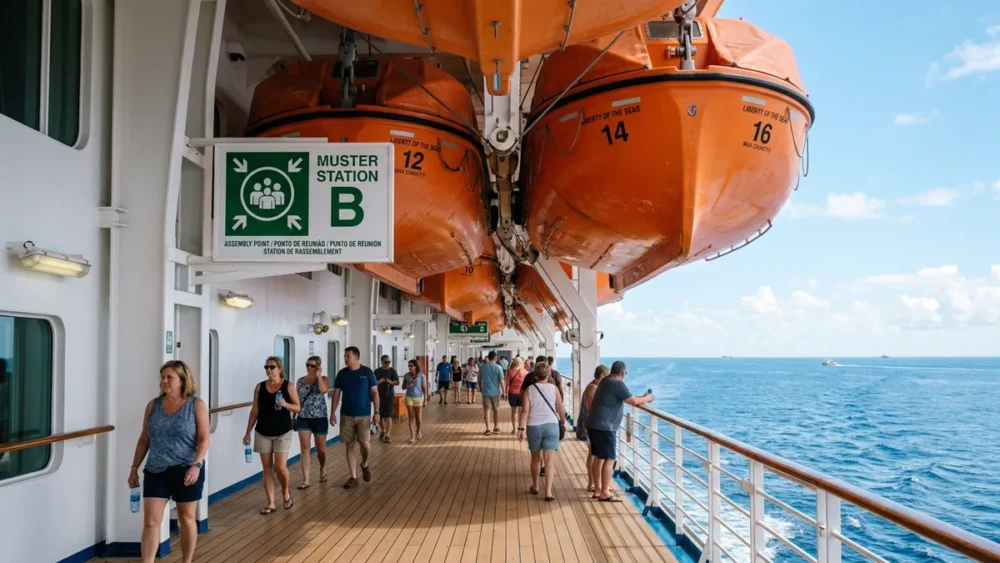
Boarding pass: The cruise ship muster drill is a legally mandatory safety briefing required by international maritime law under SOLAS Chapter III. Modern cruise lines utilize digital e-muster protocols. Passengers watch safety videos on mobile apps or stateroom televisions, listen to emergency signals, and physically visit their assigned assembly station for a quick card scan before departure.
What Is a Cruise Ship Muster Drill and Why Is It Mandatory?
Every passenger embarking on an ocean cruise must complete a safety briefing known as the muster drill. This mandatory maritime exercise ensures that all guests know where to assemble, how to don emergency lifejackets, and what actions to take in the unlikely event of an onboard emergency. It prepares every traveler thoroughly.
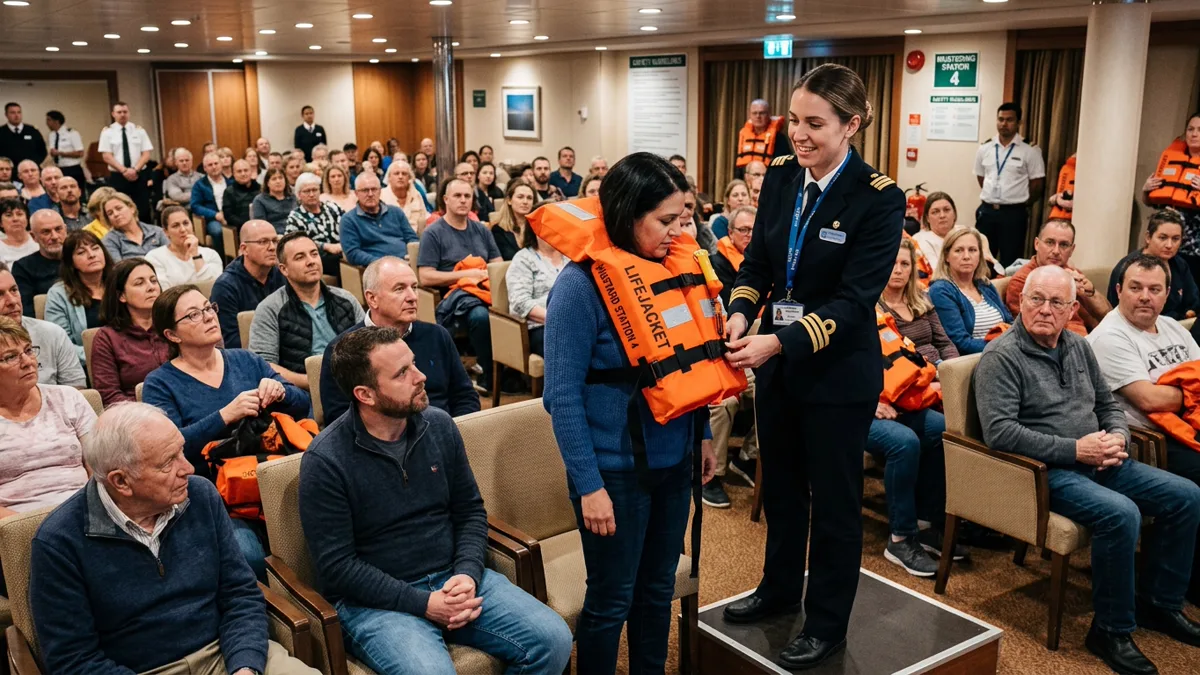
Historically, muster drills were conducted in large, crowded groups on open promenade decks. Thousands of passengers would stand shoulder to shoulder in the afternoon sun wearing bulky orange lifejackets while crew members took roll call by hand. While necessary for maritime preparedness, these traditional drills were often chaotic and uncomfortable for families traveling with small children.
Today, the cruise industry has modernized this experience. Mainstream lines have replaced the traditional mass gathering with streamlined digital e-muster systems. You can now review critical safety procedures on your personal smartphone at your own pace immediately after boarding.
Completing this briefing is a cornerstone of smooth cruise planning. Doing so early on embarkation day frees up your afternoon so you can explore pool decks and enjoy sailaway festivities without interruption.
Which International Maritime Laws Govern Safety Briefings?
Safety drills at sea are governed by strict international treaties. The legal framework is established under the International Convention for the Safety of Life at Sea (SOLAS), overseen by the International Maritime Organization (IMO).
Specifically, SOLAS Chapter III, Regulation 19.2.2 (as amended in 2015 following the Costa Concordia incident) mandates that a passenger safety briefing must take place either immediately before departure or immediately upon departure from the embarkation port. Prior to this regulatory update, maritime rules allowed ships up to 24 hours after leaving port to conduct the safety drill.
Under current IMO standards and United States Coast Guard regulations, no passenger vessel may depart a commercial harbor unless 100% of newly embarked guests have completed their required safety orientation. The ship captain is legally accountable for total passenger compliance.
Review the standard safety benchmarks required across all commercial passenger vessels:
| Regulatory Element | SOLAS Standard Requirement | Modern Cruise Implementation |
|---|---|---|
| Briefing Timing | Prior to or immediately upon departure | Completed within 2 hours of boarding |
| Lifejacket Demonstration | Proper donning instructions for all ages | In-app HD video plus crew demonstration |
| Emergency Horn Signal | Seven short blasts followed by one long blast | Audio broadcast via app and shipboard PA |
| Station Verification | Physical identification of assembly point | In-person physical check-in and card scan |
| Attendance Tracking | 100% mandatory roll call accountability | Real-time digital barcode scanning |
Safety is non-negotiable at sea. For more first-time voyage pointers, see our comprehensive guide for a first time cruise traveler.
How Does the Digital E-Muster Process Work Step by Step?
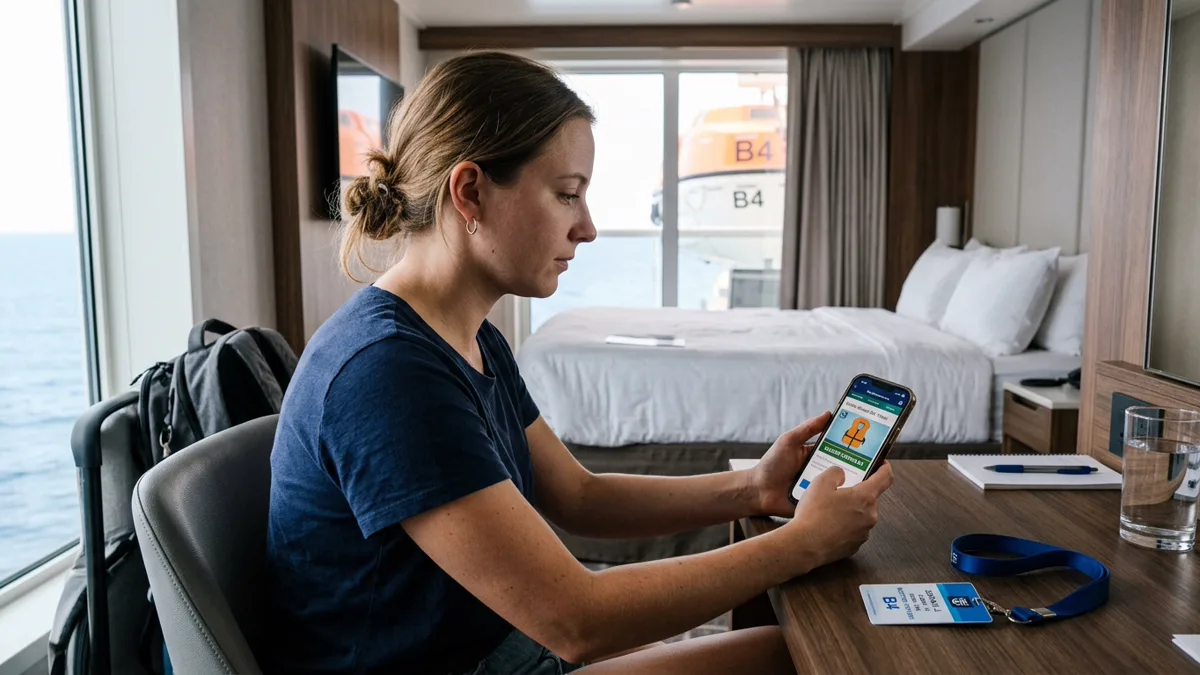
Modern digital muster (branded as eMuster on Royal Caribbean and Celebrity, or Smart Muster across other fleets) transforms an hour-long ordeal into a quick 10-minute task. You complete the process using your cruise line smartphone app or stateroom interactive television.
Follow these three simple steps upon boarding:
- Watch the Safety Video: Open the cruise line app on your phone. Watch the mandatory video demonstrating lifejacket fitting, water entry techniques, and emergency whistle operation. The app does not allow fast-forwarding.
- Listen to the Emergency Horn Signal: The app plays an audio sample of the general emergency signal: seven short horn blasts followed by one prolonged horn blast. You must listen to the complete audio track to proceed.
- Visit Your Muster Station: Walk to your designated assembly station. A crew member stationed at the entrance scans your stateroom keycard or digital boarding pass, confirming your physical presence. They verify you know your route and answer any questions.
The entire physical check-in takes less than 60 seconds once you arrive at the station. For parents traveling with young kids, crew members provide specialized infant lifejackets and wristbands identifying your stateroom number.
Do not delay your station visit. Many cruise lines pause pool bars and stateroom television entertainment shortly before scheduled departure times to ensure all remaining guests report to their assembly zones promptly.
Should You Bring Your Lifejacket to the Assembly Station?
No. You should never bring your lifejacket to your modern cruise muster drill. Cruise lines strictly instruct guests to leave lifejackets in their cabins or storage lockers during the briefing to maintain clear, hazard-free walkways.
In the past, guests were required to retrieve lifejackets from stateroom closets and wear them to the drill. However, maritime safety experts discovered that thousands of passengers dragging loose straps and buckles down narrow stairwells created severe tripping hazards.
During a real emergency, lifejacket distribution depends on ship architecture. On many modern mega-ships, adult lifejackets are stored directly in large deck lockers adjacent to the lifeboat boarding stations, ensuring rapid access during an evacuation. On other vessels, lifejackets remain in your stateroom wardrobe. For cabin layout details, review our guide on choosing the best cabin on a cruise ship.
Keep hands free. Wear comfortable walking shoes and bring only your stateroom keycard or smartphone when reporting to your assembly point.
How Do You Find Your Designated Emergency Assembly Location?
Your muster station is assigned based strictly on your stateroom location to balance passenger flow across lifeboat decks during an emergency. Your assembly point is never chosen at random.
You can locate your assigned station letter or number in multiple places:
- Stateroom Keycard: Printed prominently in the corner of your plastic sea pass card (such as “MUSTER: B-04” or “STATION D”).
- Stateroom Door Backing: A detailed evacuation diagram is posted on the inside of your cabin door, mapping the primary and secondary stairwell escape routes.
- Mobile Cruise App: Displayed on the home screen of the cruise line smartphone application under the safety dashboard.
- Digital Boarding Pass: Listed on your digital wallet pass used during terminal check-in.
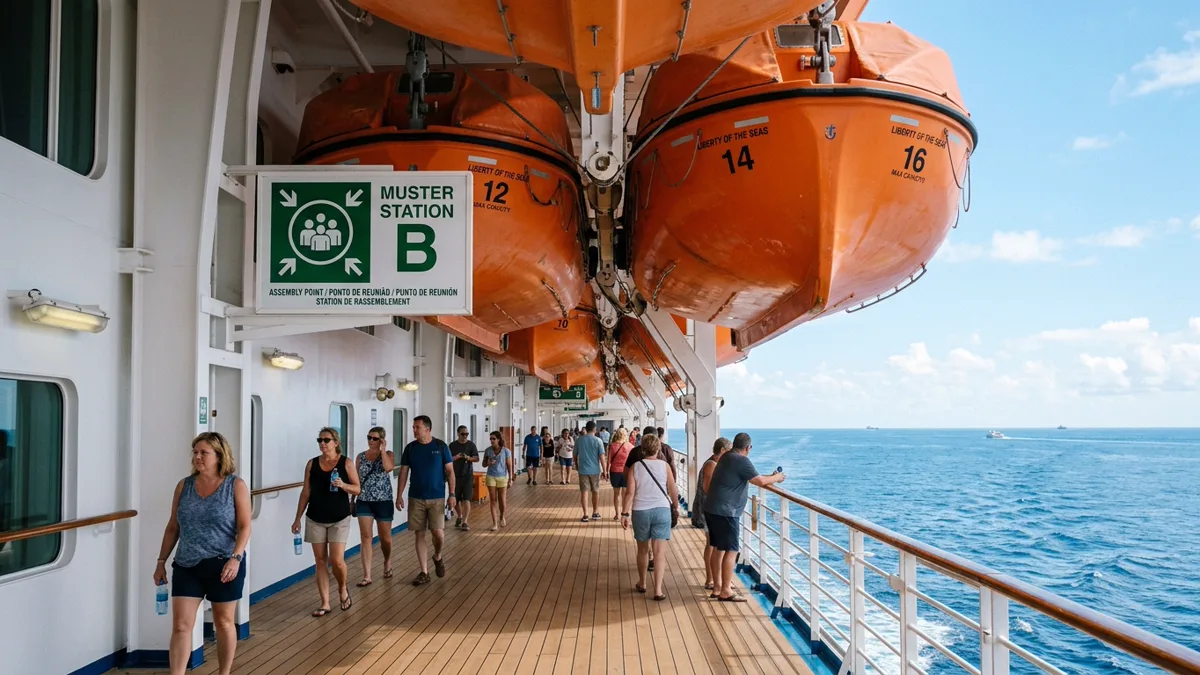
Muster stations are typically situated in large public indoor venues, such as the Main Dining Room, the Royal Theater, the Casino lounge, or along the enclosed promenade deck, directly below the exterior lifeboat davits.
What Happens If You Fail to Complete the Safety Briefing?
Because maritime law strictly prohibits ships from sailing without 100% safety compliance, cruise lines enforce rigorous protocols for non-compliant passengers.
If you fail to complete your digital briefing and station check-in within the designated embarkation window, the cruise line takes escalating operational actions:
- Onboard Account Locks: Cruise lines automatically suspend onboard charging privileges. Your keycard will not purchase drinks, book specialty dining, or access ship amenities until your station check-in is cleared.
- Public Paging: Stateroom numbers and passenger names of non-compliant guests are broadcast over the shipwide public address system.
- Mandatory In-Person Briefings: Guests who ignore digital drills are summoned to an in-person safety briefing with the ship safety officer prior to departure.
- Denial of Boarding and Disembarkation: Under standard passenger contract terms, cruise lines reserve the absolute legal right to disembark non-compliant passengers without refund or compensation before the ship casts off lines.
Get it done immediately upon boarding. Complete your digital safety check-in as soon as you step on board, unpack your daypack essentials with our cruise packing list, and kick off your holiday completely stress-free with total peace of mind.
Muster Drill Safety FAQ
Do babies and children have to attend the muster drill?
Yes. Every passenger on the ship manifest must be accounted for at their assigned muster station, including infants and young children. Crew members at the station will provide children with designated emergency safety wristbands.
How long does a digital e-muster drill take to complete?
The video and audio briefing on your phone takes approximately 5 to 7 minutes to watch, while the physical station check-in takes less than 60 seconds.
Do you need an internet package to complete the e-muster drill on the app?
No. Cruise line smartphone apps operate on the ship’s local Wi-Fi network free of charge without requiring a paid internet package.
What is the general emergency alarm signal on a cruise ship?
The international maritime general emergency alarm signal consists of seven short blasts on the ship’s whistle and alarm bells, followed by one prolonged blast.
How we researched this: Maritime safety rules, SOLAS regulatory amendments, and digital e-muster protocols are verified against official International Maritime Organization (IMO) conventions and United States Coast Guard passenger vessel safety guidelines as of October 2026.